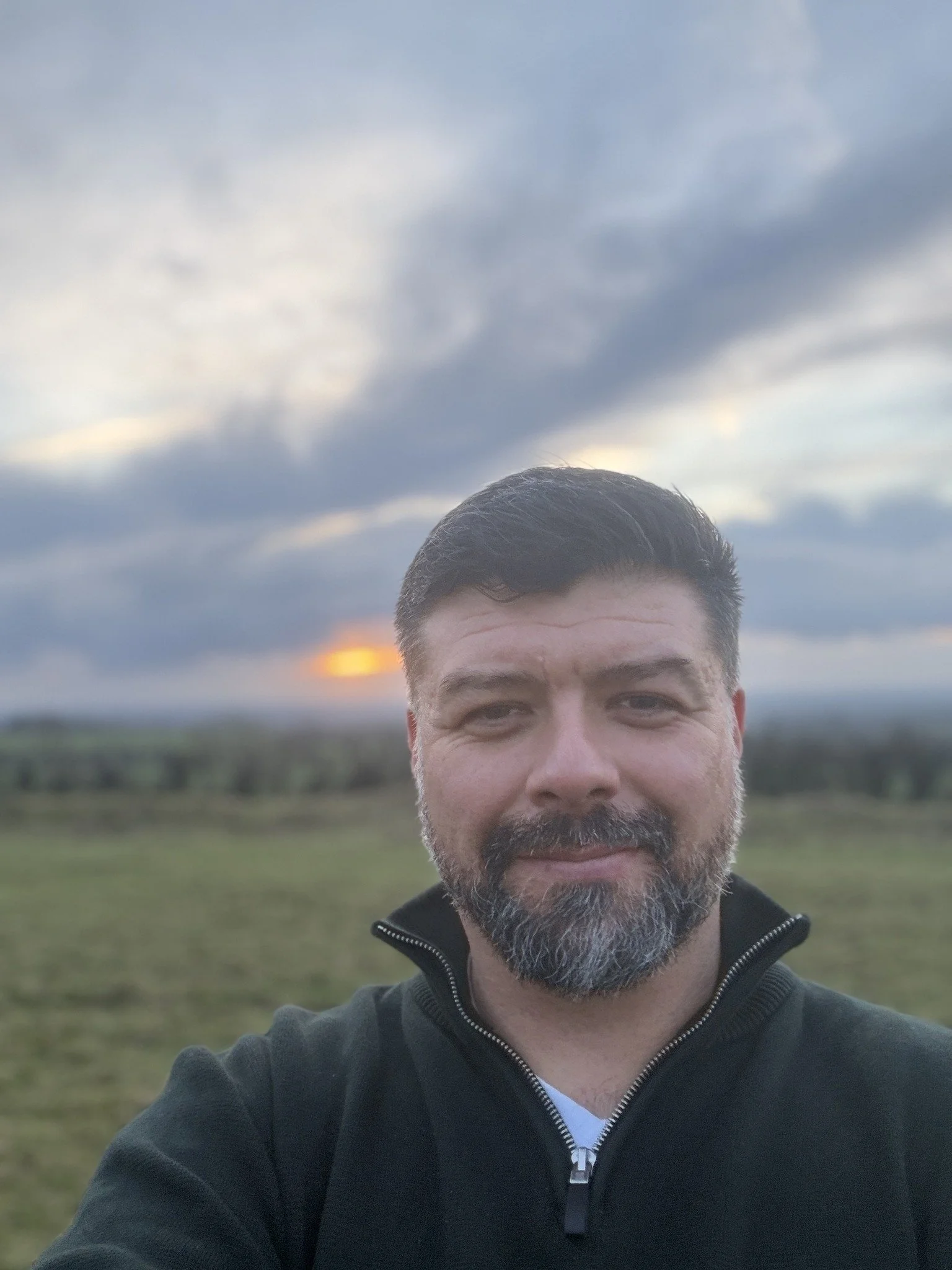
About Me: James Byrne (he/him)
Psychotherapist · Clinical Supervisor · Educator
A Space for Reflection, Depth, and Change
I founded The Threshold Practice as a place for reflection, depth, and care. A space for the moments when life asks us to change, and for those who are ready to meet that change with honesty.
Much of my work focuses on the inner lives of gay and bisexual men, exploring how shame, intimacy, masculinity, identity, and belonging shape the way we move through the world.
Many of the men who come here appear to be managing life well on the surface. Work, friendships, relationships. Yet privately, they carry something heavier: loneliness, difficulty with intimacy, or a quiet sense of not quite belonging.
Often, beneath it all, there is shame.
Not loud shame, but the quieter kind. The feeling that something about you is too much, not enough, or somehow out of place.
Understanding Shame
Shame, in this sense, is not the feeling that we have done something wrong. It is the deeper feeling that something about us is wrong.
It often sounds like:
I am too much.
I am not enough.
If people really saw me, they would leave.
Love or belonging might not be for someone like me.
For many, particularly gay and bisexual men, this begins long before there are words for it. It grows out of subtle experiences of exclusion, silence, or the feeling of being different in ways that are not welcomed.
Over time, that feeling shapes how we live: how much of ourselves we show, how close we allow others to come, and what we believe we deserve in love, intimacy, and belonging.
In therapy, shame is not something to be removed. It is something to be understood.
Often, it has been protecting a very vulnerable part of us. The part that learned early on that being fully seen might not be safe.
The work is to meet that part with care, and slowly discover that the story shame tells about who we are is not the only story available.
How I Work
Therapy with me is relational, trauma-informed, and grounded in real connection. It's not about fixing you. It's about understanding you.
We pay attention to what is happening in your inner world. Your thoughts, emotions, body, and relationships, and how patterns may have formed over time.
Sessions take place online, allowing you to access the work from wherever you are. For clients based in Dublin, walk-and-talk psychotherapy is also offered in Phoenix Park.
There is no expectation to arrive with everything figured out. Part of the work is finding a way to understand what has been hard to name.
Who I Work With
I work with men navigating:
Shame and belonging
Intimacy and relationships
Masculinity and vulnerability
Sexuality, including kink and alternative expressions
Non-monogamy and diverse relationship structures
Neurodivergence
Identity, connection, and community
These are not simply areas of professional interest. They are communities and experiences I am connected to personally as well as clinically, allowing the work to be grounded in understanding rather than distance.
The Inner Adolescent
Much of my work with adults is in quiet conversation with the adolescent they once were.
Many of the wounds we carry as gay and bisexual men, the shame, the self-protection, the careful management of how much to show, were formed during the years when we were first learning who we were and how the world received us. The teenage self does not always go away. Often it goes quiet and waits.
In therapy, I often talk about the inner adolescent rather than only the inner child. The adolescent in us still carries the longing to be seen, the defiance of not being understood, and the tenderness of becoming.
I also continue to work clinically with adolescents themselves and with parents trying to understand the young people in their lives. It is a stage I find continually interesting to sit with, to teach on, and to return to in my own reflection. The years when so much of who we become is quietly decided.
Some of what I bring to that work is also rooted in my own formative years as a young queer man, including the wounds I still carry and continue to learn from.
A Little About Me
Many of the men who work with me say that what matters most is not only professional training, but the sense that they do not have to explain or justify parts of their lives here.
Much of my time outside therapy is spent outdoors. In the garden, at my allotment, or wandering hills, forests, and mountains without a particular destination. The Irish landscape, the sea, the greenways, the slow weather, is where I return to find ground.
More recently, I have begun working with ceramics, which has become another way of learning patience, attention, and the slow process of shaping something by hand. I share my home with my cats: Emilio, Púca, and Sharon (there are stories behind those names). Community matters deeply to me. Over the years, I have founded and been involved in a number of projects, some that flourish, and others that remain works in progress.
Background
Before becoming a psychotherapist, I worked in nursing and social care. These experiences shaped my understanding of care, dignity, and the complexity of people's lives.
Alongside my clinical work, I have been holding spaces for men for over fifteen years. For the past decade, much of this has taken the form of queer men's retreats, weekend gatherings in rural Ireland that have shaped how I understand group process, intimacy, vulnerability, and the ways men come into relationship with themselves and each other. Other projects have grown alongside the retreats, some flourishing into long-running offerings, others remaining quieter attempts at the same essential question: how do we make spaces where men can be honest with themselves and with each other?
I am currently engaged in doctoral research at GCAS College Dublin, exploring story, identity, and belonging in the lives of gay and bisexual men. My research looks at how shame, intimacy, masculinity, sexuality, and community shape the stories we tell about who we are, with particular attention to the impact of digital spaces.
I am a member of WPATH and EPATH and have presented at international conferences on gender and sexuality.
Rainbow Minds Centre
I am also the Founder and Clinical Director of Rainbow Minds Centre, a separate but related practice offering therapy with other GSRD and Neurodivergent specialist therapists, as well as reduced-fee online therapy with student and graduate therapists working under clinical supervision.
Through Rainbow Minds, I also develop and deliver specialist clinical training in gender, sexuality, and relational practice, including a year-long Diploma in GSRD Therapy. The training work brings together clinicians, supervisors, and frontline practitioners working with queer clients and communities, and it is one of the most generative parts of my professional life.
Learn more about Rainbow Minds →
Qualifications
PhD Researcher (in progress). Humanities and Social Sciences, GCAS College Dublin
MSc Adolescent Psychotherapy. University of Northampton
BA (Hons) Psychotherapy and Counselling. Institute of Integrative Counselling and Psychotherapy (IICP), Dublin
Diploma in Counselling and Psychotherapy. IICP, Dublin
Further professional training in clinical supervision, trauma, and gender, sexuality, and relationship diversity (GSRD)
Specialist Certifications
ADHD Clinical Services Provider (ADHD-CCSP)
Certified Autism Spectrum Disorder Clinical Specialist (ASDCS)
Professional Memberships
Accredited Member, British Association for Counselling and Psychotherapy (MBACP Accred)
World Professional Association for Transgender Health (WPATH)
European Professional Association for Transgender Health (EPATH)
Book your intro call below